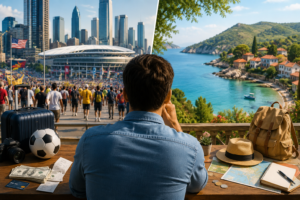
Why some trips feel longer than they are
Learn why some trips feel longer than they are and discover practical strategies to make short getaways feel deeper and more memorable.
What Makes a Short Trip Feel Deep
Have you ever returned from a three-day trip feeling like you were away for a week?
Worse, do you remember another destination where you spent seven days and everything went by too fast? The objective length of a trip is the same for everyone—what changes is perception.

Understanding why some trips feel longer than they actually are can transform the way you plan.
1. Novelty expands time perception
The brain pays more attention to what is new. When you visit a place for the first time, every corner becomes a different stimulus.
Architecture, accents, smells, sounds, and urban dynamics. The more novelty, the more “mental markers” are created. And the more markers, the longer the experience feels when you look back on it.
In practical terms, a short trip to a completely new destination can feel longer than a week in a familiar place.
2. Experience density matters more than duration
There is a simple concept: experience density. It’s not about doing more things. It’s about living moments that truly differ from one another.
Imagine a weekend in a city where you can attend shows, dine at award-winning restaurants, and walk through lively streets at night.
Even in 48 hours, the contrast between environments creates multiple layers of memory.
Compare that with four days repeating the same pattern (hotel–beach–hotel–beach). Relaxing? Yes. But memory tends to compress everything into a single block.
If you want a trip to “feel long,” increase the diversity of contexts, not necessarily the number of activities.
3. A controlled pace slows perception
Interestingly, rushed trips tend to feel shorter. When you run from one attraction to another, the brain shifts into execution mode, not absorption mode.
When arriving at a natural setting, you can move quickly and leave right away. Or you can sit down, observe the changes, and walk in silence.
The second scenario creates emotional depth. And depth increases the sense of duration.
4. Trips with contrast feel longer
Contrast is a memory accelerator. A combination like urban days followed by time in nature creates the feeling of two trips in one.
The brain loves clear changes in scenery. When there is a visible transition—city to nature, mountain to desert, culture to relaxation—time seems to expand.
That’s why many travelers are structuring hybrid itineraries: part active, part contemplative.
5. Real presence extends memory
You can spend five days in Miami distracted by your phone—or three days fully immersed.
The difference isn’t the destination. It’s attention. Noticing details, talking to locals, trying the food, and walking without rushing registers deeper nuances.
Trips that feel long are usually trips where you were truly present.
6. Micro-trips can feel like macro experiences
A growing trend in the U.S. is short, strategic travel. A Friday night flight, returning Sunday afternoon.
Destinations like Washington, D.C., or Boston work perfectly in this model.
Why?
- High concentration of attractions
- Easy walkability
- Strong cultural density
In two or three days, it’s possible to experience history, gastronomy, walking tours, and museums. Geographic compactness helps maximize the perception of value and depth.
The common mistake: confusing quantity with depth
Many American travelers plan trips like task lists. Especially in iconic destinations like Los Angeles or Orlando, the temptation to “see everything” is enormous.
But the more you try to fit in, the less you absorb.
The result? Fatigue, shallow memories, and the feeling that it all flew by.
How to make a short trip feel longer
If you want to maximize the sense of duration, focus on these principles:
1. Include contrast
Mix different environments.
2. Slow down
Leave space between activities.
3. Prioritize anchor moments
Choose one or two truly memorable experiences.
4. Explore on foot whenever possible
Walkable cities expand sensory perception.
5. Reduce digital distractions
Memory requires attention.
If you’re planning your next getaway, don’t just ask, “How many days do I have?”
Ask instead, “How can I structure those days so they feel bigger than they are?”

Related content
Spring travel trends across the U.S.
Discover the top U.S. spring destinations gaining popularity and learn how to choose the right trip based on weather, and travel goals.
Keep reading * You will remain on the current website