
Solo or group travel: find out which is making you spend more
Compare solo and group travel costs in 2026. See which option saves more money on flights, hotels, food and transportation.
The truth about the costs of traveling alone or in a group
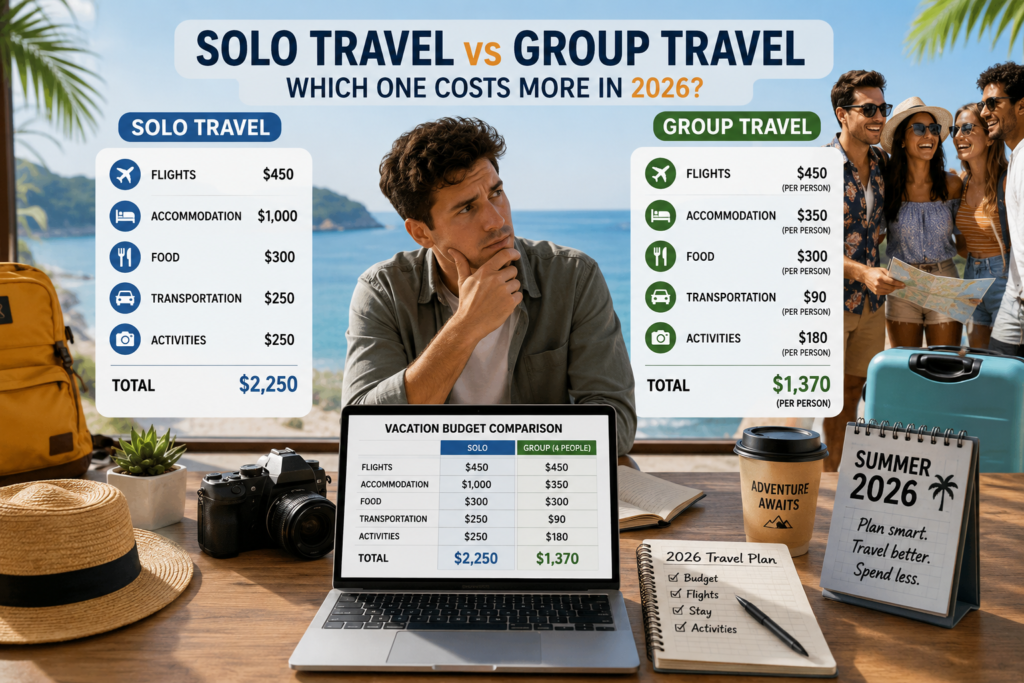
If planning a vacation feels more expensive this year, you’re not imagining it.
Travel costs across the United States have climbed sharply, forcing millions of Americans to rethink where they go, how long they stay, and even whether they travel at all.
According to Deloitte’s 2026 Summer Travel Survey, only 45% of Americans plan to take a summer vacation involving paid lodging, the lowest level recorded in six years.
That reality has sparked a question many travelers are asking before booking their next trip:
Is solo travel or group travel actually cheaper in 2026?
The answer depends on where your money goes, and some of the biggest costs may surprise you.
Quick Answer: Is Solo Travel or Group Travel Cheaper?
For most travelers, group travel is cheaper when accommodations and transportation can be shared.
However, solo travel can become the less expensive option when:
- You book last-minute deals.
- You travel with flexible dates.
- You stay in hostels or budget accommodations.
- You avoid activities driven by group preferences.
- You don’t need larger accommodations or rental vehicles.
In general:
| Expense Category | Solo Travel | Group Travel |
|---|---|---|
| Flights | Similar | Similar |
| Hotels | Higher | Lower |
| Vacation Rentals | Higher | Much Lower |
| Rental Cars | Higher | Lower |
| Tours | Higher | Lower |
| Dining | Similar | Similar |
| Flexibility | Higher | Lower |
| Hidden Costs | Lower | Higher |
The biggest savings from group travel come from splitting fixed costs. The biggest savings from solo travel come from flexibility.
Why Travel Costs Matter More in 2026
Airfare Is Rising Faster Than Inflation
The U.S. Travel Association’s Travel Price Index reported that airline fares increased 20.7% year-over-year in May 2026.
NerdWallet’s Travel Inflation Report found airfare increases reaching 26.7% annually, significantly outpacing overall inflation.
For travelers, this means airfare now consumes a larger portion of vacation budgets than it did just one year ago.
A family or travel group may save on lodging, but everyone still buys their own airline ticket.
Hotels Continue to Pressure Budgets
Hotel prices increased by more than 4% annually, according to travel inflation data.
Meanwhile, vacation rental demand remains strong in popular summer destinations.
Because accommodation is often the second-largest travel expense after flights, this is where group travel typically creates the biggest financial advantage.
The Real Cost Breakdown of Solo Travel
Let’s examine how expenses look for a typical five-day domestic vacation.
Flights
Solo travelers generally pay the same airfare as everyone else.
The advantage comes from flexibility. A solo traveler can choose cheaper departure dates, inconvenient flight times, or alternative airports without needing approval from others.
Hotels
This is where solo travelers face their biggest disadvantage.
A hotel room costing $240 per night costs:
- $240 per night for one traveler
- $120 per person for two travelers
- $60 per person for four travelers
The room cost doesn’t change. Only the number of people sharing it does.
Food
Solo travelers often spend less because they can:
- Skip restaurants
- Buy groceries
- Eat street food
- Take advantage of hotel breakfasts
There is no pressure to match the group’s dining preferences.
Transportation
Rental cars, rideshares, and parking fees are fully absorbed by one person.
This can dramatically increase the daily travel budget.
Activities
Many attractions offer group discounts.
Solo travelers usually pay full price.
In addition, some tour operators charge “single supplements” to compensate for unused capacity.
The Real Cost Breakdown of Group Travel
Flights
Airfare usually remains identical to solo travel.
However, coordinated schedules can reduce flexibility, forcing travelers to book more expensive flights that fit everyone’s availability.
Hotels
This is where groups win.
Vacation rentals and multi-bedroom accommodations spread costs across several travelers, often reducing lodging expenses by 30% to 70%.
Food
Group dining can create mixed results.
Shared groceries lower costs, but restaurant choices often become more expensive due to varying preferences.
Transportation
Rental vehicles create major savings.
For example:
- One rental SUV shared by four travelers
- Gas split four ways
- Parking split four ways
The per-person cost can drop dramatically compared to solo transportation.
Activities
Many attractions offer:
- Family pricing
- Group packages
- Multi-person discounts
These savings can add up quickly over a week-long vacation.
Solo Travel vs Group Travel Cost Comparison Example
Below is a realistic example for a five-night domestic vacation in summer 2026.
| Expense | Solo Traveler | Group of 4 (Per Person) |
|---|---|---|
| Airfare | $450 | $450 |
| Hotel/Vacation Rental | $1,000 | $350 |
| Transportation | $250 | $90 |
| Food | $300 | $300 |
| Activities | $250 | $180 |
| Total | $2,250 | $1,370 |
Actual costs vary by destination, but the pattern remains consistent:
Group travel usually wins because lodging and transportation are shared.
When Solo Travel Is Actually Cheaper
Many travelers assume groups always save money.
That’s not always true.
Last-Minute Trips
A solo traveler can grab:
- One discounted airline seat
- One discounted hotel room
- One cancellation deal
Groups rarely find enough inventory to benefit from these opportunities
Flexible Schedules
According to travel experts cited by NerdWallet, flying on lower-demand days can generate meaningful savings. Solo travelers have far more flexibility to take advantage of those pricing patterns.
Budget Backpacking
Hostels, budget hotels, and public transportation can make solo travel surprisingly affordable.
Many backpackers spend less than organized groups because they build their entire itinerary around cost control.
Hidden Costs Most Travelers Forget
Group Coordination Expenses
Groups frequently spend more on:
- Reservations
- Upgraded accommodations
- Larger vehicles
- Activities chosen to satisfy everyone
Single Occupancy Fees
Many cruises and guided tours charge extra fees for solo travelers.
This can significantly increase total trip costs.
Shared Costs That Become Unequal
Groups don’t always split expenses evenly.
One traveler may:
- Upgrade rooms
- Choose expensive restaurants
- Add premium excursions
This can create unexpected spending pressure for the entire group.
How Americans Are Adjusting Travel Budgets in 2026
The economic environment is changing travel behavior.
According to Deloitte:
- Only 45% of Americans plan paid-lodging vacations this summer.
- One-third of non-travelers cite travel costs as the primary reason for staying home.
- Travelers still taking vacations expect to spend more than $4,000 on their main trip.
Reuters reports that rising flight and hotel costs are creating a growing divide between higher-income travelers and budget-conscious households.
Americans are becoming more strategic about travel spending than at any point since the pandemic recovery.
Author’s Opinion
If your goal is purely financial, group travel usually offers the best value in 2026.
The math is difficult to ignore. Sharing accommodation, transportation, and activities often cuts hundreds of dollars from the final bill.
However, cost isn’t the only factor.
Solo travel provides flexibility that can create savings opportunities unavailable to groups. More importantly, many travelers place a premium on independence, spontaneity, and personal experiences.
For budget-conscious travelers, the best approach may be a hybrid strategy:
- Travel solo during flexible, off-peak periods.
- Travel with a group during peak seasons when hotel prices are highest.
That combination often delivers the best balance between cost savings and travel freedom.
Final Verdict: Which Travel Style Gives Better Value?
For most Americans planning trips in 2026: Group travel is usually cheaper.
The ability to split lodging, transportation, and activity costs creates significant savings that solo travelers cannot easily replicate.
The best choice depends on your travel style.
If saving money is your top priority, group travel generally wins.
If flexibility and independence matter more, solo travel may provide better overall value, even if the final bill is slightly higher.

Related content
Family-Friendly Destination or Adults-Only Escape
Pick the trip that matches your real lifestyle.
Keep reading * You will remain on the current website Family-Friendly Destination or Adults-Only Escape
Keep reading You will remain on the current website