
Airbnb vs hotel: what travelers get wrong when comparing the two
Learn the common mistakes travelers make when comparing Airbnb and hotels before booking a stay.
What is the best option to choose?
The debate between Airbnb and hotels has become one of the most common discussions in travel planning.
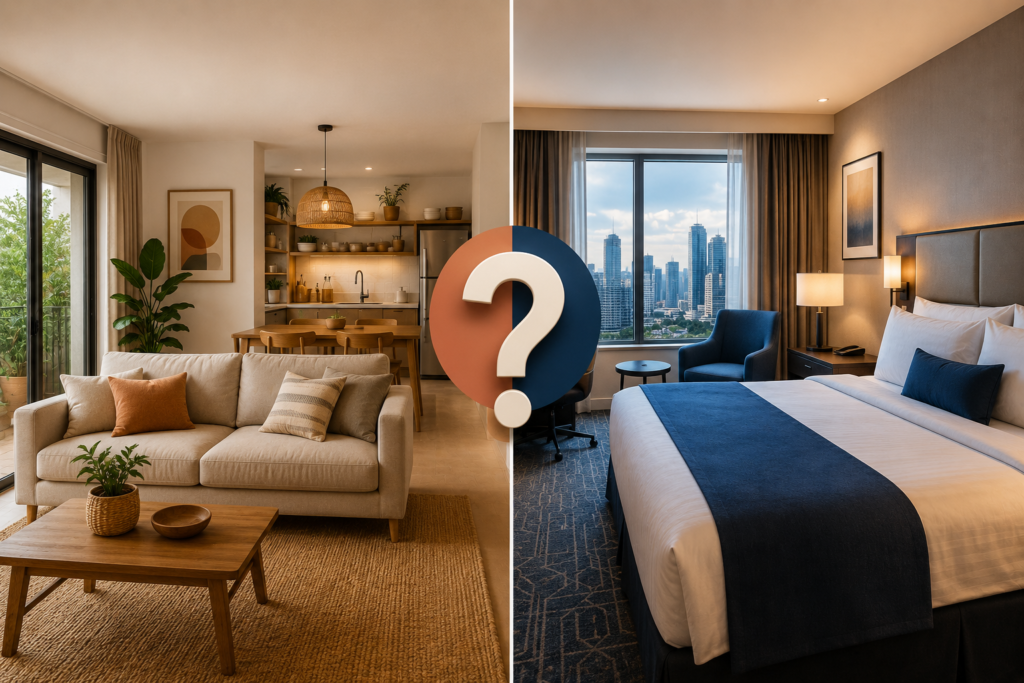
Yet many travelers approach the comparison using assumptions that don’t always reflect how accommodation costs, convenience, and traveler behavior work in practice.
The scale of both industries helps explain why the discussion remains relevant.
Airbnb reported 491.5 million Nights and Experiences Booked globally in 2024, generating $81.8 billion in Gross Booking Value, according to the company’s Full Year 2024 Financial Results.
At the same time, traditional hotels continue to capture a large share of both leisure and business travel demand across the United States.
The problem is that travelers often compare accommodations using headline prices, social media recommendations, or personal anecdotes rather than evaluating the total value of the trip.
The $150 Airbnb that isn’t really $150
One of the most common mistakes occurs before travelers even reach the checkout page.
Consider a hypothetical three-night stay.
Initial Search Results
| Accommodation | Advertised Price |
|---|---|
| Airbnb | $150/night |
| Hotel | $220/night |
At first glance, the Airbnb appears significantly cheaper.
However, accommodation costs often extend beyond the nightly rate.
Example of a final booking cost
| Cost Component | Airbnb | Hotel |
|---|---|---|
| Nightly Rate | $450 | $660 |
| Cleaning Fee | $145 | Included |
| Service Fee | $58 | Included |
| Taxes | $55 | $82 |
| Total | $708 | $742 |
In this scenario, the apparent $210 gap shrinks to just $34.
The purpose of this example is not to suggest that hotels are always cheaper. Instead, it illustrates why comparing only the nightly rate can produce misleading conclusions.
Costs travelers frequently overlook
- Cleaning fees
- Service fees
- Occupancy taxes
- Resort fees
- Parking charges
- Pet fees
- Additional guest fees
The smartest comparison is always based on the final checkout price.
What industry data says about traveler preferences
A common misconception is that Airbnb has replaced hotels for most travelers.
Industry surveys suggest otherwise.
According to multiple Morning Consult surveys commissioned by the American Hotel & Lodging Association (AHLA), hotels remain the preferred lodging choice among U.S. business travelers, with recent surveys showing preference levels ranging from 60% to 71%, depending on the survey period and methodology.
The same research found that hotels remain the leading choice among Americans planning overnight leisure trips.
Why travelers continue choosing hotels
| Reason | Why It Matters |
|---|---|
|
Consistency
|
Predictable experience |
|
Front desk support
|
Immediate assistance |
|
Loyalty programs
|
Points and rewards |
|
Business services
|
Meeting traveler needs |
|
Daily housekeeping
|
Reduced workload |
These factors rarely appear in Instagram posts or TikTok reviews, but they often influence guest satisfaction.
Why trip length changes the entire calculation
The economics of accommodation change dramatically depending on how long a traveler stays. Cleaning fees create one of the clearest examples.
| Length of Stay | Cleaning Cost Per Night |
|---|---|
| 2 nights | $87.50 |
| 3 nights | $58.33 |
| 5 nights | $35.00 |
| 7 nights | $25.00 |
| 14 nights | $12.50 |
This helps explain why Airbnb properties often become more competitive as trip length increases.
| Stay Duration | Often Better Value |
|---|---|
|
1–2 nights
|
Hotel |
|
3–4 nights
|
Depends |
|
5–7 nights
|
Similar |
|
7+ nights
|
Airbnb often becomes more competitive |
Why families and couples should not use the same booking strategy
Travel advice often becomes misleading because travelers assume their own preferences apply universally.
Consider two common U.S. travel scenarios.
Scenario A: couple visiting Chicago
Priorities often include:
- Walkability
- Dining access
- Public transportation
- Convenience
- Short stay
Scenario B: family visiting Orlando
Priorities often include:
- Multiple bedrooms
- Laundry facilities
- Kitchen access
- Shared living space
- Lower food expenses
These priorities create different accommodation needs.
Comparison
| Feature | Hotel | Airbnb |
|---|---|---|
|
Multiple bedrooms
|
Expensive | Common |
|
Kitchen
|
Rare | Common |
|
Laundry
|
Limited | Often available |
|
Shared family space
|
Limited | Common |
|
Grocery storage
|
Limited | Easy |
This is why families frequently report stronger value from vacation rentals than couples on short city trips.
The hidden cost of convenience
Price is easy to measure, but convenience is not.
Yet convenience often shapes the overall travel experience.
Hotels have spent decades refining operational systems designed to reduce friction for guests.
Common Hotel Services
- 24-hour front desk
- Daily housekeeping
- Luggage storage
- Immediate maintenance support
- Concierge assistance
- On-site dining
Convenience Comparison
| Service | Hotel | Airbnb |
|---|---|---|
| Front Desk | Usually available | Rare |
| Daily Cleaning | Common | Rare |
| Luggage Storage | Common | Rare |
| Maintenance Support | Immediate | Varies |
| Late-Night Assistance | Common | Varies |
For a traveler arriving after a delayed flight or dealing with an unexpected issue, these services may have significant practical value.
The kitchen advantage is real
One of Airbnb’s strongest selling points is access to a kitchen.
The savings can be substantial for certain travelers.
Example: Family of Four
| Meal | Restaurant | Grocery-Based |
|---|---|---|
| Breakfast | $50 | $12 |
| Lunch | $70 | $25 |
| Dinner | $120 | $45 |
| Daily Total | $240 | $82 |
However, many travelers overestimate how often they will cook.
Vacation behavior frequently differs from pre-trip expectations.
People tend to:
- Eat out more often;
- Spend longer hours exploring;
- Prioritize convenience over meal preparation.
A kitchen creates value only if travelers actually use it.
The question most travelers forget to ask
The biggest mistake in the Airbnb-versus-hotel debate is asking:
“Which one is better?” A more useful question is: “Which one is better for this specific trip?”
Data from Airbnb, hotel industry organizations, and traveler surveys all point toward the same conclusion: there is no universal winner.
Hotels typically excel in convenience, consistency, and business travel.
Airbnb often excels in space, longer stays, and group accommodations.
The travelers who make the best decisions are usually not the ones chasing the lowest advertised price. They are the ones comparing total trip costs, understanding how stay length affects value, and choosing the accommodation that best matches how they actually travel.
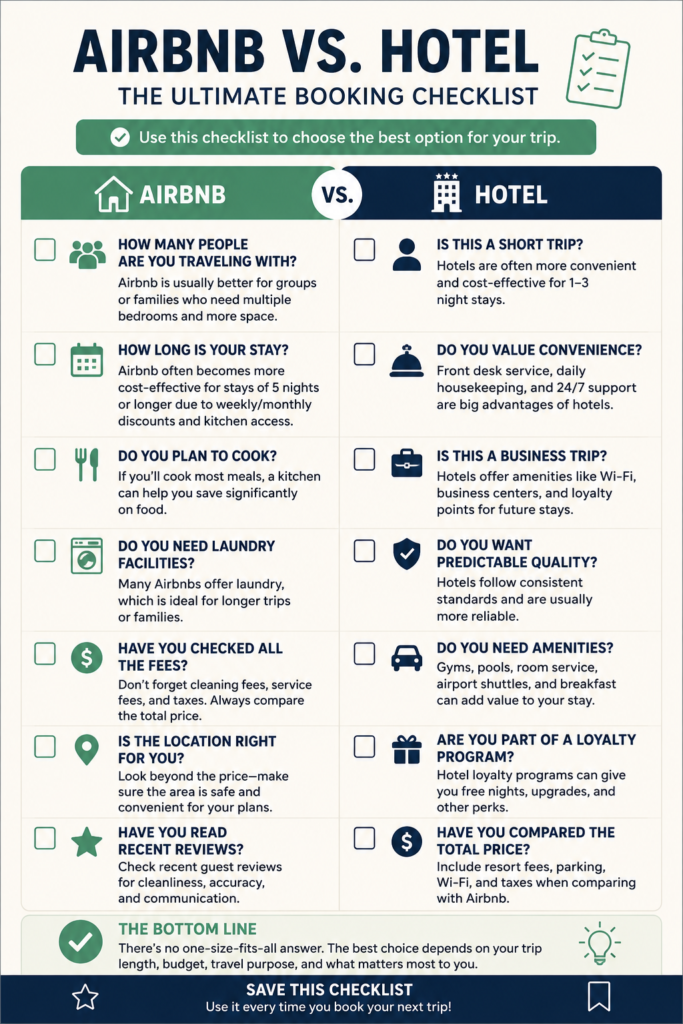
Airbnb vs. hotel: a quick booking checklist
Before booking your next stay, use this checklist to compare more than just the nightly rate.
Factors such as cleaning fees, trip length, location, convenience, kitchen access, and group size can significantly affect the overall value of your accommodation.
A few minutes of comparison today could help you avoid unnecessary costs and choose the option that better fits your travel needs.
Frequently Asked Questions